

 Megan Banta
Heber City • McKeil Mahoney took a couple of deep breaths to ward off happy tears as she stood in the home of her new garage.
Mahoney and her husband, DJ, grew up in the Heber Valley but had been living about 40 minutes away since they got married. They weren’t able to live closer to family until they qualified with Self-Help Homes, a Provo-based nonprofit that helps families build houses in rural areas.
“For us, there’s no other way we could afford to be up here,” Mahoney, a massage therapist, said during a snowy celebration before they and nine other families got the keys to their new homes. “To be near both our families.”
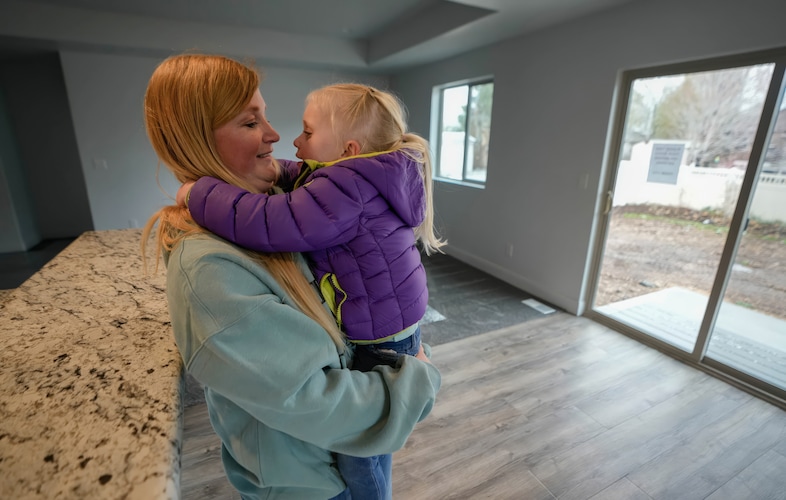
(Francisco Kjolseth | The Salt Lake Tribune) McKeil Mahoney holds her daughter Camryn, 3, as they get ready to move into their new home in the Wasatch Vista community in Heber City.
Yet “countless rural households” likely won’t have access to that same opportunity now, U.S. Sen. John Curtis and nine other senators wrote in a recent letter to the U.S. Department of Agriculture.
That agency provides grants to nonprofits like Self-Help Homes, as well as loans to people through its Single-Family Housing Programs. But they recently announced changes that will reduce loan amounts for applicants while making the process more complex.
Curtis, a Republican who began his first term in the Senate last year after representing eastern Utah in Congress for nearly a decade, was joined by Sen. Mike Crapo, an Idaho Republican, asking the USDA to rescind the changes. The group also included several Democrats.
“Homeownership is the cornerstone of the American Dream, but all too frequently, it is out of reach for rural Americans,” the senators wrote last month. “While we applaud all efforts to properly steward taxpayer dollars, we believe these revisions make the program less efficient and may leave families in our states without a path to homeownership.”
The USDA has defended its changes, saying in an emailed statement that they are intended to “reduce overall program costs and make room for additional loans.” They also have started a program in Utah and 23 other states to let nonprofits fill some financing gaps and get loans on more expensive properties than the changes initially allowed.
Curtis and representatives for most other members of Utah’s federal delegation did not respond to requests for comment. A spokesperson for Rep. Blake Moore, who represents northern Utah, said he is “actively engaged” with the issue.
‘A huge blessing’
Since 1949, the USDA’s Single-Family Housing Programs have helped millions of families buy or build homes in rural areas without needing a down payment.
That includes direct loans to families and loans through financial institutions.
It also includes grants to help organizations like Self-Help Homes carry out construction projects. The organizations provide materials and assist people who make less than 80% of the middle income in a given area as they construct their own homes. They also hire contractors for specialized work that people can’t do on their own.
The group members provide most of the labor on each other’s homes, with technical assistance from the organization overseeing the project.
The Mahoneys are among 10 families – including six originally from Heber – moving into homes that they mostly built themselves in less than eight months. Their tasks ranged from framing and roofing to cabinetry and finishings for plumbing.
The program wasn’t without challenges, Mahoney said, recalling one Saturday when it took them “all freaking day” to successfully install one four-foot piece of the top of a wall.
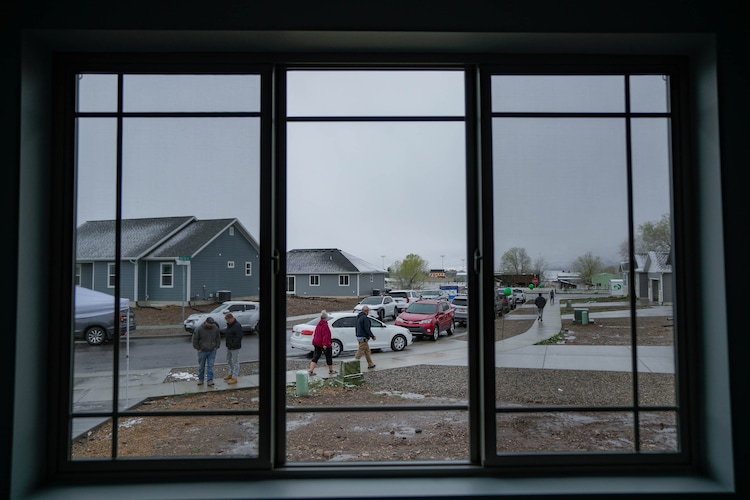
(Francisco Kjolseth | The Salt Lake Tribune) People attend an open house for part of a third phase of the community called Wasatch Vista in Heber City, featuring 10 new homes, on Thursday, April 2, 2026.
But all in all, she said, it was rewarding and “a huge blessing.”
Changes had an ‘immediate and local’ effect
Now, fewer families will likely have access to the program after the USDA announced changes that, among other things, limit how much funding individuals and organizations can receive. The policy updates also prohibit loans when the appraised value of a home exceeds the loan limit.
The new loan limits vary from $324,700 in many of the state’s less-populated counties to $698,200 in Summit and Wasatch counties.
The changes were meant to “ensure we serve more rural Americans and keep the program strong for the long term” and decrease delinquency rates, a USDA spokesperson told The Salt Lake Tribune.
But the changes had an “immediate and local” effect in the opposite way, Self-Help Homes said. Thirteen families working with the organization were denied loans as of March 24. In recent years, the group has assisted around 60 families per year, based on annual reports.
Utahns working with similar programs across the state, including in Cache Valley, also saw their dreams of home ownership crushed because of the changes.
That happened because the construction cost – and therefore their loan amount – is much lower since families do much of the labor themselves, while the organizations purchase materials and hire subcontractors at cost.
Many of the projects Self-Help Homes was planning now exceed the new loan limit, effectively disqualifying families who would otherwise have been eligible.
The changes also were fundamentally misaligned with home prices, Curtis and the other senators wrote. Those have been soaring because of “stubborn inflation, construction costs and other supply-side challenges,” they added.
The federal agency did announce a pilot program for Utah and 23 other states that allows for exceptions.
That pilot allows the value of homes constructed through the self-help program to exceed the loan limit. It also allows organizations to work with other financing partners, like Utah’s Olene Walker Housing Loan Fund, to fill the gap between what people can borrow and the cost of the house.
Brad Bishop, who heads Self-Help Homes, said both approaches will help in areas like Wasatch, Utah and Washington counties.
But Utahns in places like Cache County may not qualify under the pilot, Bishop said, because the gap between the loan limits and housing values is too wide.
The changes were meant to “ensure we serve more rural Americans and keep the program strong for the long term” and decrease delinquency rates, a USDA spokesperson told The Salt Lake Tribune.
But the changes had an “immediate and local” effect in the opposite way, Self-Help Homes said. Thirteen families working with the organization were denied loans as of March 24. In recent years, the group has assisted around 60 families per year, based on annual reports.
Utahns working with similar programs across the state, including in Cache Valley, also saw their dreams of homeownership crushed because of the changes.
That happened because the construction cost – and therefore their loan amount – is much lower as they do much of the labor themselves, while the organizations purchase materials and hire subcontractors at cost.
Many of the projects Self-Help Homes was planning now exceed the new loan limit, effectively disqualifying families who would otherwise have been eligible.
The changes also were fundamentally misaligned with home prices, Curtis and the other senators wrote. Those have been soaring because of “stubborn inflation, construction costs and other supply-side challenges,” they added.
The federal agency did announce a pilot program for Utah and 23 other states that allows for exceptions.
The pilot allows the value of homes constructed through the self-help program to exceed the loan limit. It also allows organizations to work with other financing partners, like Utah’s Olene Walker Housing Loan Fund, to fill the gap between what people can borrow and the cost of the house.
Bishop said both approaches will help in areas like Wasatch, Utah and Washington counties.
But Utahns in places like Cache County may not qualify under the pilot, Bishop said, because the gap between the loan limits and housing values is too wide.
